CQOR Is Becoming the New EBITDA: Why Healthcare Supply Chain Leaders Are Rewriting Performance Metrics for 2026
We at SupplyCopia Research are seeing a clear shift across the U.S. healthcare industry: the way supply chain performance is measured is fundamentally changing. Traditional KPIs like unit price reduction, inventory turns, or purchase price variance are no longer enough. In boardrooms, finance reviews, and system-wide transformation programs, a new metric is taking center stage — Cost, Quality, Outcomes, and Resilience (CQOR).
This isn’t marketing language. It’s how leading health systems, GPOs, and healthcare supply chain organizations are responding to rising costs, persistent shortages, regulatory pressure, and executive scrutiny heading into 2026 and beyond.
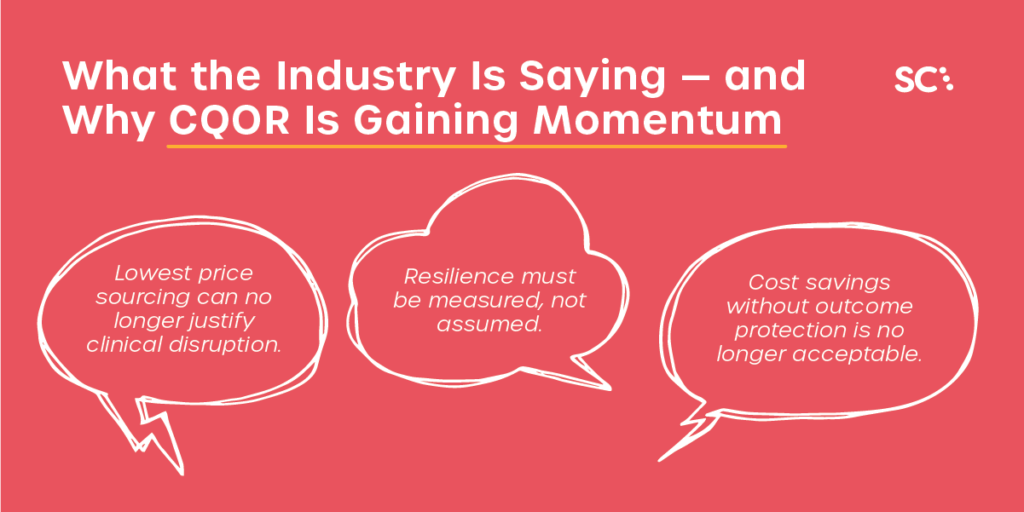
What the Industry Is Saying — and Why CQOR Is Gaining Momentum
Across healthcare supply chain conferences, executive roundtables, and strategy papers, a consistent theme has emerged:
“Cost savings without outcome protection is no longer acceptable.”“Lowest price sourcing can no longer justify clinical disruption.”“Resilience must be measured, not assumed.”
Industry leaders are acknowledging hard truths:
U.S. hospitals operate on razor-thin margins — often 2–3% or less, making supply chain decisions directly tied to financial survival.
Drug and medical supply shortages have become structural, not episodic, forcing organizations to evaluate suppliers based on reliability and risk, not just price.
Clinical outcomes are now financially linked, as value-based care models continue expanding.
Disruptions carry real cost, from canceled procedures to clinician overtime and emergency sourcing.
As a result, supply chain performance is being reframed around CQOR — a composite lens that aligns procurement decisions with enterprise outcomes.
The Problem: Most Organizations Still Measure the Wrong Things
Despite this shift, many healthcare organizations remain stuck with outdated measurement frameworks:
Cost tracked in isolation, without visibility into downstream clinical or operational impact
Quality monitored separately by clinical teams, disconnected from sourcing decisions
Outcomes reviewed retrospectively, not linked back to supply choices
Resilience discussed after disruptions, not modeled proactively
This fragmentation creates a dangerous gap between what executives want to know and what supply chain data actually shows.
That gap is exactly where CQOR becomes transformative.
What CQOR Really Means for Healthcare Supply Chains in 2026
CQOR is not a dashboard. It’s a decision framework.
It forces leaders to ask smarter, harder questions:
What did we save — and what did that saving cost us operationally?
Which suppliers consistently protect outcomes, not just pricing?
Where are we exposed if demand spikes or supply fails?
Which sourcing decisions increase resilience without eroding margins?
In forward-thinking organizations, CQOR is already influencing:
Contracting and supplier scorecards
Strategic sourcing and standardization decisions
Capital allocation and risk mitigation planning
Executive reporting to CFOs and boards
How We at SupplyCopia Operationalize CQOR (Not Just Talk About It)
At SupplyCopia, we built our CQOR framework because we saw a consistent failure across the industry: organizations wanted to think holistically, but their data, tools, and processes wouldn’t let them.
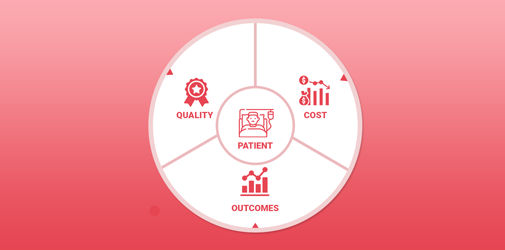
Our CQOR approach enables healthcare supply chain leaders to connect the dots between cost, quality, outcomes, and resilience using real operational data.
Cost
We aggregate and normalize spend across products and services, uncovering hidden leakage, off-contract spend, and variation that traditional reports miss.
Quality
We align supplier and item data with performance signals — enabling organizations to understand which suppliers consistently meet expectations and which introduce downstream risk.
Outcomes
CQOR links supply decisions back to operational and clinical realities, helping leaders assess whether sourcing strategies support or undermine enterprise goals.
Resilience
We help organizations identify concentration risk, single-source dependencies, and disruption exposure before those risks become crises.
This is what transforms supply chain from a cost center into a strategic operating system.
Why CQOR Is a CFO-Level Conversation Now
CFOs are increasingly asking supply chain leaders for answers that traditional metrics can’t provide:
How exposed are we if this supplier fails?
What is the financial impact of a disruption — not just the price difference?
Which cost reductions are sustainable without hurting outcomes?
CQOR gives finance leaders defensible, data-driven answers — not anecdotes.
In 2026, supply chain leaders who cannot speak in CQOR terms will struggle to justify decisions at the executive level. Those who can will shape strategy.
The Bottom Line
The healthcare industry is moving past “cheapest wins.” It’s moving toward “best total impact wins.”
We at SupplyCopia believe CQOR is becoming the new standard language of healthcare supply chain leadership. Not because it sounds good — but because it reflects the realities of cost pressure, outcome accountability, and constant disruption.
The organizations that master CQOR won’t just survive the next decade. They’ll lead it.

 ALL Solutions