Integrating Patient-
Reported Outcomes into
Procurement Decisions:
The Untapped Advantage of CQOR
As we all know, U.S. healthcare supply chains are under immense pressure in 2025. At the same time, value-based reimbursement models are tying payment to both clinical quality and patient satisfaction—putting unprecedented pressure on supply chain leaders to deliver outcomes, not just products.
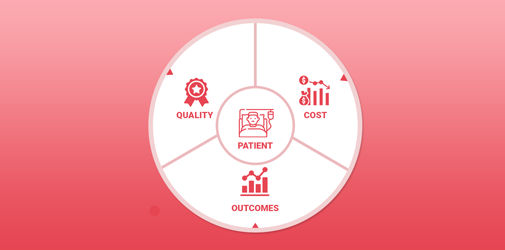
We at SupplyCopia understand that traditional procurement—focused only on unit price—no longer works in this environment. Our software, CQOR (Cost, Quality, Outcomes, and Reimbursements , addresses this challenge by helping supply chain executives integrate patient-reported outcomes (PROs) into purchasing decisions. CQOR doesn’t interact with patients directly; instead, it analyzes PRO data already collected by your clinical teams—such as patient satisfaction scores, pain levels, recovery times, and functional outcomes—and links this information to the specific products and suppliers used in care delivery.
The Current U.S. Healthcare Supply Chain Crisis:
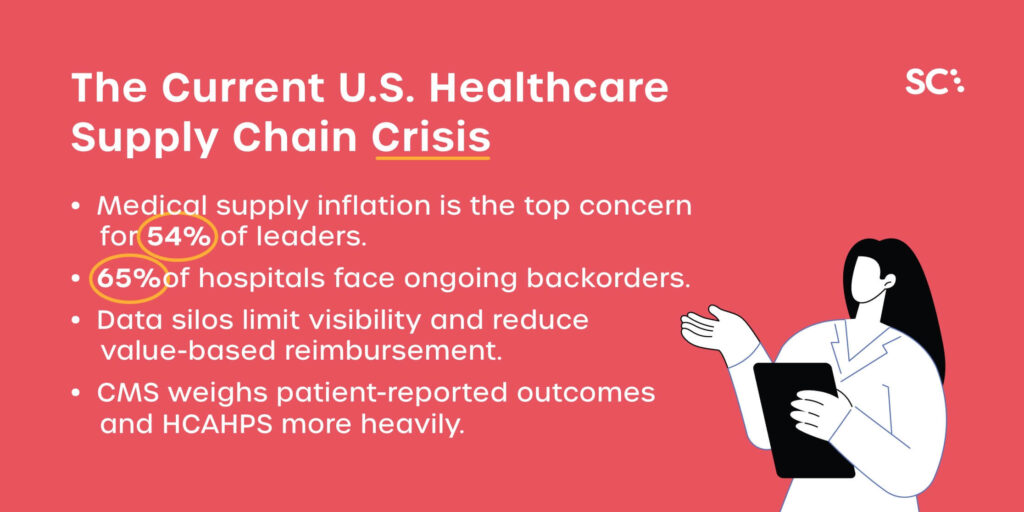
Persistent inflation: Medical supply costs are rising faster than general inflation, with 54% of supply chain leaders citing price increases as their top threat.
Chronic shortages: 65% of hospitals face ongoing backorders on essential items, forcing last-minute sourcing at premium prices and compromising patient safety.
Data silos: Most organizations cannot rapidly connect supply usage to patient outcomes or satisfaction—leaving millions in value-based reimbursement unclaimed.
Value-based care pressure: CMS now factors patient-reported outcomes directly into payment models, and health systems are increasingly measured by HCAHPS and other patient experience metrics.
How CQOR Solves These Problems by Leveraging Patient-Reported Outcomes:
Unified Analytics Platform: CQOR integrates data from your EMR (including PRO data), ERP, and procurement systems into a single dashboard—eliminating silos and enabling supply chain leaders to see which products actually deliver better patient experiences and clinical outcomes.
Evidence-Based Product Selection: Instead of selecting supplies based solely on cost, CQOR enables you to filter by real patient feedback. For example, if patients report lower pain scores and faster recovery with Brand A wound dressings versus Brand B, CQOR surfaces this insight so your team can make informed choices. One health system using integrated PRO data in procurement reduced readmissions by 17% and saved millions annually by switching to products with better patient-reported outcomes.
Actionable Dashboards: CQOR’s AI-driven analytics instantly identify underperforming products—those linked to lower patient satisfaction, higher complication rates, or longer recovery times—allowing your team to act quickly and avoid future purchases that don’t deliver value.
Supports Value-Based Reimbursement: By directly linking supply utilization to reimbursement codes and patient outcome metrics, CQOR helps you maximize returns under CMS value-based payment programs. Health systems using integrated procurement analytics with CQOR have reported 15%–20% reductions in total supply expenditures while simultaneously improving patient satisfaction scores.
Cost Reduction Through Better Decisions: When you can see that Product X leads to fewer complications, shorter hospital stays, and higher patient satisfaction than Product Y—even if Product X costs slightly more upfront—the total cost of care drops significantly. CQOR quantifies these trade-offs, empowering you to negotiate with suppliers based on total value, not just unit price.
Practical Implementation Steps:
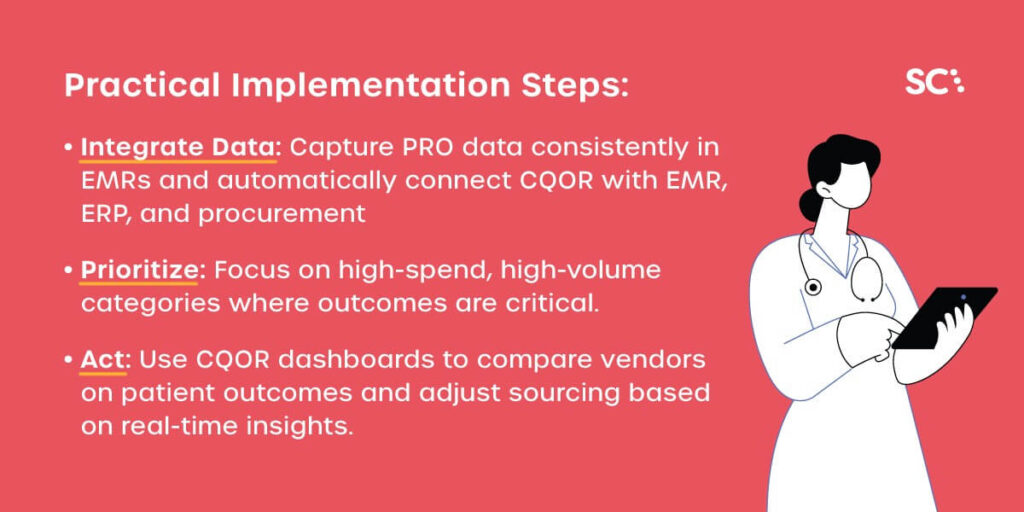
Ensure PRO Data Collection: Work with your clinical teams to ensure patient-reported outcomes are systematically captured in your EMR or patient experience systems.
Integrate Systems: Connect CQOR to your EMR, ERP, and procurement platforms so patient outcome data flows automatically into supply chain analytics.
Identify High-Impact Categories: Partner with clinical leaders to prioritize high-spend, high-volume product categories (e.g., orthopedic implants, wound care, catheters) where patient feedback can significantly influence outcomes.
Use CQOR Analytics for Sourcing: When evaluating vendors and products, use CQOR dashboards to compare not just price but patient-reported pain, satisfaction, recovery time, and complication rates.
Monitor and Optimize: Continuously track how product changes impact both costs and patient outcomes, using CQOR’s real-time reporting to refine your procurement strategy.
The Bottom Line:
In a U.S. healthcare environment defined by inflation, shortages, and relentless pressure for patient-centered, value-based care, supply chain leaders need more than traditional procurement tools. We at SupplyCopia built CQOR specifically to bridge the gap between supply chain decisions and patient outcomes—not by working directly with patients, but by giving you the analytics to understand which products truly deliver value based on what patients report about their own experiences.
If your supply chain is still making decisions without considering the voices of those who matter most—your patients—it’s time to see what CQOR can do.
By integrating patient-reported outcomes into every procurement decision, you’ll not only achieve measurable cost reduction but also improve care quality, enhance patient satisfaction, and succeed in the value-based reimbursement era.

 ALL Solutions